EV Charging Facility Optimization.
A simulated facility-siting study using mixed-integer optimization to explore charging coverage and location tradeoffs.
RESEARCH DEEP DIVE
The research approach.
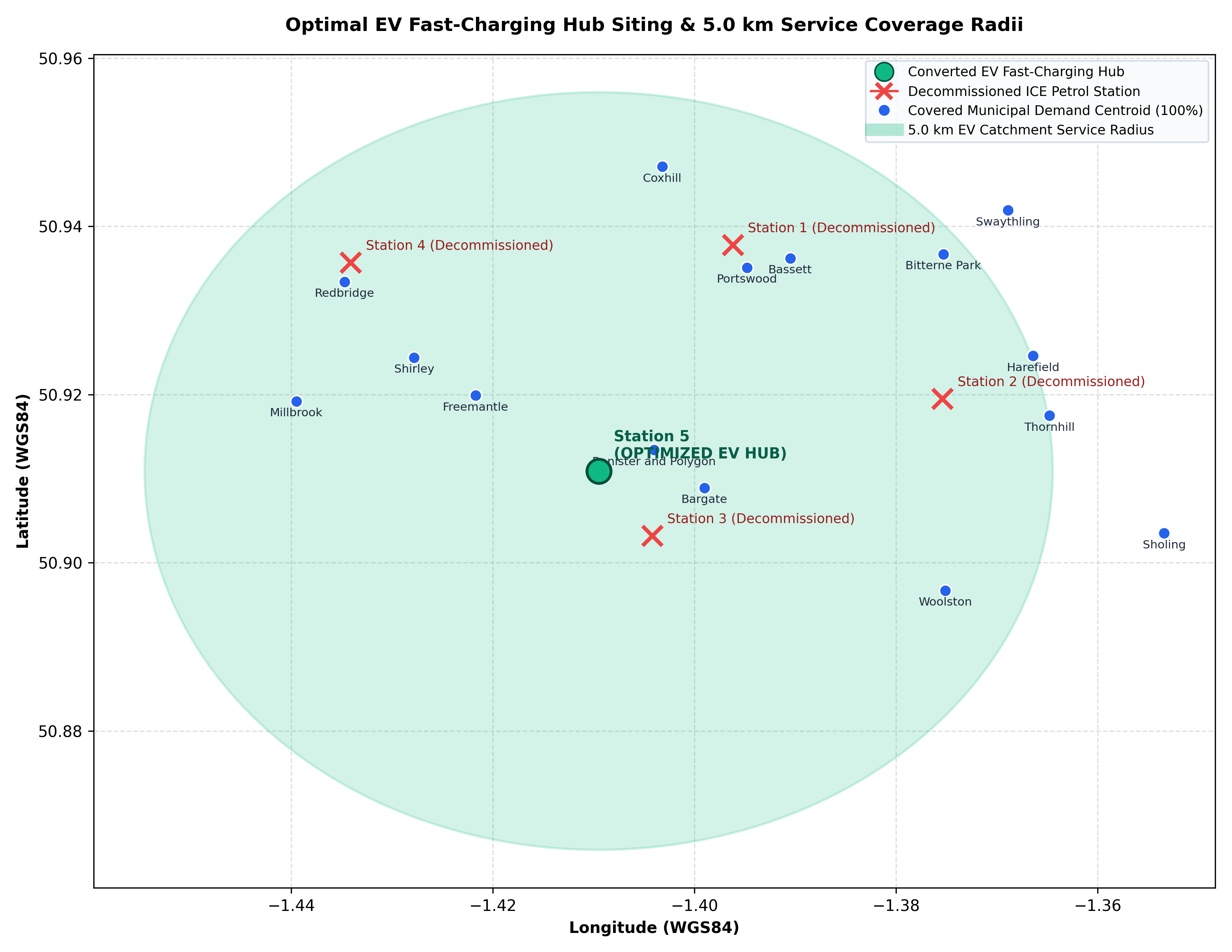
A limited number of charging sites must cover geographically distributed demand. This study explores that siting question using five candidate sites and fifteen simulated districts.
Haversine distances define the coverage relationships. Binary PuLP/CBC decisions choose sites and covered districts under a site-count limit. Clustering analysis and a Folium map help inspect the simulated solution.
Read the optimization formulation alongside the solution map. Its five-site, fifteen-district simulated testbed makes the coverage objective and site-count tradeoffs explicit.
FROM THE REPOSITORY
What's inside.
- 01
Models coverage across five candidate sites and fifteen simulated demand districts.
- 02
Uses PuLP/CBC with binary siting and coverage decisions under a site-count limit.
- 03
Includes Haversine distance calculations, clustering, and a Folium solution map.
These notes summarize the reviewed implementation and available artifacts. Open the original source for code, documentation, and subsequent changes.
Open the original repository